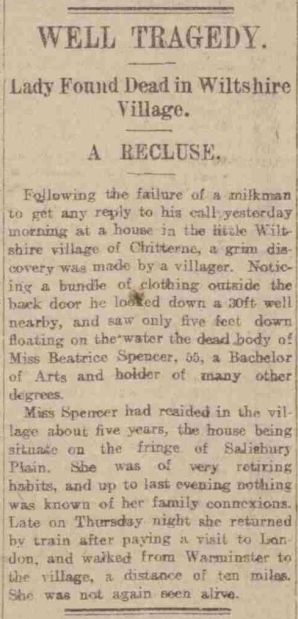
 Exeter & Plymouth Gazette 20 February 1926
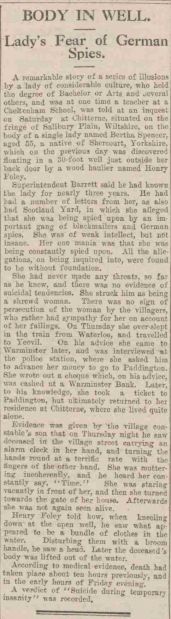 Aberdeen Press & Journal 22 February 1926
Sunday 3rd December 2014 - Bertha Spenser
Bertha Spenser was buried at All Saints graveyard in Chitterne but not in the consecrated ground. She was buried just outside the surrounding fence in the opposite corner from the entrance gate. When I made the plan of the graveyard 10 years ago I read the date on her gravestone as 1925, wrongly as it turned out. When NL cleaned up the gravestones this last summer he rightly pointed out that in fact Bertha was buried in 1926.
Previously not too much was known about Bertha, except that she committed suicide, hence the reason for her burial place. But now H&W have looked into the whole episode and discovered contemporary and informative newspaper articles about her death on 19 February 1926. Two are pictured below.
Exeter & Plymouth Gazette 20 February 1926Aberdeen Press & Journal 22 February 1926
There are some anomalies in these two reports, such as her age, she was 49 when she died, and the two different accounts of who found the body, but both say Bertha was an educated woman from Yorkshire, who appeared to have been suffering from mental disturbance. Other than those few facts we still know little about her.
H&W made a surprising discovery in the probate records for Bertha. Beneath her entry, which states that she lived at Cotsmere, Townsend, Chitterne, was a probate record for her brother Norcliffe Spenser of Halifax, Yorkshire, who died only a few months after his sister. This discovery has of course left us with yet another mystery, why?
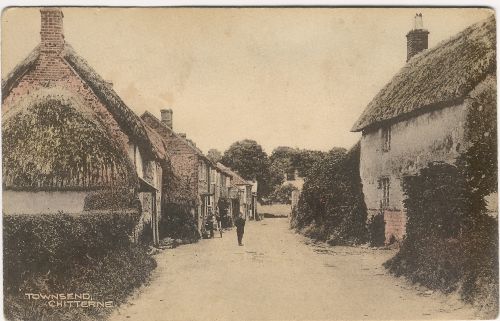
Cotsmere no longer exists, but I think it may be the thatched cottage on the right of the old photograph below.
Sunday 23rd November 2014 - Hitchcocks of All Saints
Following on from my last blog we now know a lot more about the Hitchcock family who lived and farmed at All Saints Manor Farm in Chitterne. This new information is all thanks to my good friends J & RR, AKA Holmes and Watson.
Harry Hitchcock and his wife Jane we are pretty sure arrived to farm in Chitterne in 1832. Prior to this they had farmed at Bushton farm, Bushton, near Cliffe Pypard in the north of Wiltshire. On 15 March 1832 Harry's notice appeared in the Devizes & Wiltshire Gazette:
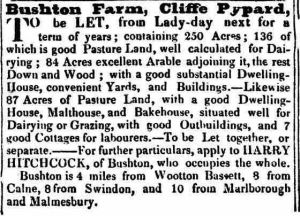
Harry and Jane and their nine children were about to take on a much bigger farm. Manor Farm at that time consisted of over 1600 acres of pasture and arable land and included many tied cottages for farm workers in the village and at the distant field barns, as well as the ancient farmhouse in the centre of the village.
The Hitchcock children ranged in age from 23 to 3 years, from Henry the eldest to Frederick the baby of the family. They were to leave behind two more sons who were buried in St Peter's Churchyard back in Cliffe Pypard, Edmund who had died aged 3 years and George aged 14.
Harry and Jane were both about 45 years old in 1832 so I suspect the move was prompted by Henry's coming of age. He in fact went on to farm in Chitterne until his death in 1869. But we are leaping ahead, much was to happen to the family in Chitterne in the meantime.
Of the other children in 1832, John aged 21, Charles aged 19, Jane aged 16, William aged 14, Edmund (named after the one who died) aged 12, Anne aged 8 and Frederick aged 3 we know a little more, but not as much as about Henry. John became a vicar at Harmondsworth near London, Charles became a doctor and worked at Market Lavington Asylum, Jane never married and stayed at Manor Farm until her death aged 49, William became an attorney and solicitor in London, Anne died aged 21 and Frederick farmed in Chitterne alongside his brother Henry and died just one year earlier than Henry in 1868. Every member of Harry and Jane's family is remembered on the family tombstones in All Saints graveyard.
In 1852, when 65 year-old Harry was lying in his sick bed, the farmhouse and farm buildings were destroyed by a disastrous fire, which appeared to have started from a spark catching the 'muckle' in the farmyard alight. Harry died a few days later on 23rd April 1852.
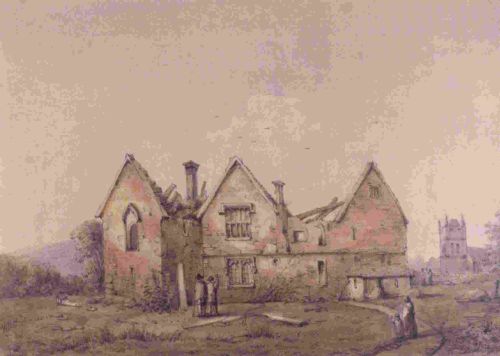
The house, which had dated from perhaps the 16th century, was rebuilt in stone in a slightly different style, but with echoes of its former shape.
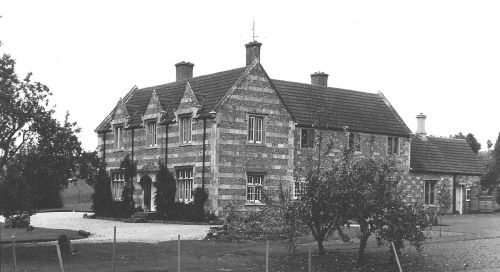
In 1853, just one year after the fire, Henry, Harry's eldest son, married Elizabeth Parsons from Timsbury, Somerset. Henry was 44 years old and Elizabeth was 26. They had nine children, eight of whom were daughters, Ann, Bessie, Jane, Alice, Rosalie, Edith, Florence and Beatrice and one son, Henry. In 1861 we find Henry the elder and his brother Frederick running the 1650 acre farm with 31 men and 17 boys.
By 1871 Henry and Frederick are dead, but their mother Jane still lives, aged 85, and their brother William, the solicitor, is running the 1800 acre farm with 21 men and 19 boys. Jane died in 1872 aged 86, and William in 1880, so in 1881 we find the 1700 acre farm being run by Henry's formidable daughters who employed 25 men and 6 boys. Their only brother did not take on the farm and died in London in 1935. By 1891 the Cleverlys had taken over Manor Farm and Ann Hitchcock and her sisters Jane, Alice and Rosalie lived with their married sister Elizabeth and her husband, the farmer George Blake, at Chitterne Lodge. The four unmarried Hitchcock sisters left Chitterne sometime before the 1901 census and lived in Heytesbury for the rest of their lives, but were buried in Chitterne All Saints. The last to go was Jane who died aged 88 years in 1945.
Comment: My two intrepid helpers, Holmes & Watson, have done it again! They really are incredible to have come up with loads more information on the family of Henry and Elizabeth Hitchcock.
First, let's right a wrong: apparently Jane was not the last of their children to go, she was outlived by her younger sister Beatrice who went into nursing. Beatrice worked as a hospital nurse in Liverpool in 1891 and Folkestone, Kent in 1901. H&W were unable to find her in the 1911 census but they are pretty sure that she died in West Hythe, Kent in 1959.
H&W have found what happened to the family after Henry died in 1869 leaving Elizabeth a widow with nine children, when there is no sign of the family in Chitterne. In the 1871 census Elizabeth has gone back to her home village, Timsbury, Somerset, to live with her sister Anne Parsons, taking with her Anne, Bessie and the four youngest children: Edith, Henry, Florence and Beatrice. Of the other three girls, Jane is at school in Poole, Dorset, while Alice and Rosalie are at the Ladies Boarding School, Sambourne, Warminster.
By 1881 the family has returned to Chitterne but without their mother Elizabeth who has died in the meantime, and the four girls, Anne, Rosalie, Edith and Beatrice, are living at Manor Farm as we said ealier. Perhaps they are not actually farming as the 1881 census says they are "occupiers of Farm managed by the executors of deceased Uncle". Uncle William presumably. Edith died in 1886 aged 24 years and Florence in 1891 aged 25 years, in, surprisingly, Frankfurt-on-Main, Germany! We do not know what she was doing there. Here I should add that H&W have pointed out that Florence's second name is definitely Mary and not Anne as some family trees state. At birth she was registered as Florence Mary, and baptised the same, but the name Mary was later erased in the record of the baptism and Anne substituted, wrongly substituted H&W think, because at her death her name at probate is again given as Florence Mary Hitchcock.
So by 1891 William's executors have sorted out his affairs and the farm has been returned to the Lords of the Manor, the Onslows, and leased to the Cleverly family. The Hitchcock sisters have dispersed elsewhere in Chitterne. They did not all go to live with their sister Elizabeth as I stated in my blog aboove. Three of them, Anne, Jane and Rosalie are living on their own means at The Grange. Only Alice has moved in with her married sister Elizabeth and her husband George Blake at Chitterne Lodge, possibly to help with George and Elizabeth's son born 1890, George Hitchcock Blake. By the time of their daughter, Elizabeth Hitchcock Blake's birth, in 1894, the Blakes have moved to Amesbury and Alice and her sisters have presumably decamped to Heytesbury where we find them in 1901 living in a house named Swallowcliffe in Church Walk. Alice died in 1904 and Anne in 1909, leaving Jane and Rosalie at Church Yard, Heytesbury in 1911. Rosalie died in 1934 and Jane in 1945 as we saw before. On both their probate records their address is given as 68 High Street, Heytesbury. With Beatrice's death in 1959 that just about wraps up the Hitchcock story as far as Chitterne is concerned.
Many thanks to H&W, I couldn't do this without their great support. SR.
Sunday 16th November 2014 - All Saints Graveyard
A gentleman knocked on my door back in the early summer this year and asked if he might have a copy of the map of All Saints graveyard and a list of the people buried there. I gave him the copies and thought no more about it except when several villagers told me as the summer went on that a man was often in the graveyard cleaning the tombstones.
At the beginning of this month I was pleasantly surprised to receive a letter from the very same man, NL, detailing annotations to my list of burials following his cleaning of the stones and his discovery of a burial that was not on my list at all. Aren't people amazing? I have no idea why he spent his time this way, but would dearly love to know. I have written and asked if he has any connection to Chitterne, so maybe we shall see.
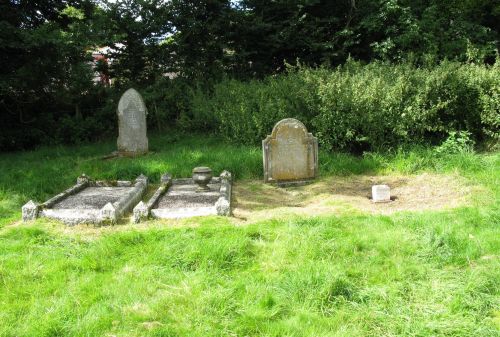
The new grave NL had found was marked by an inscribed cube vase he had unearthed. The vase marking the grave of James and Elizabeth Grant (nee Poolman) was in a corner of the graveyard next to the grave of Hannah Ellen Cummings Capron. The inscription on the vase says J W Grant but James' death is registered under the name J J Grant. James died in 1942 and Elizabeth in 1963.
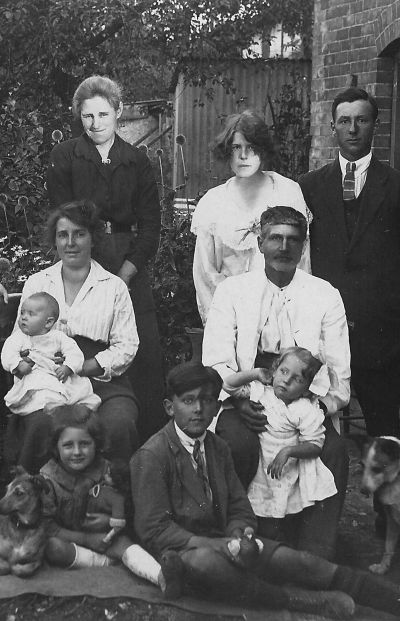
James was a lengthsman, keeping the verges cut and tarring the village roads when necessary. He and Elizabeth lived in Bidden Lane and had six children. A granddaughter, CG, still lives in the village.
Graves numbers 1 and 2 were inscribed M.H. and B.H. and NL has found that they mark the burials of Mary and Betty Heath, daughters of William and Betty Heath, who both died in 1778.
Grave number 4 belongs to Bessie Eva Furnell who died in 1884.
Grave number 37 belongs to Isabella Vincent, wife of Francis Vincent in grave 36, she died in 1779 and Francis in 1792.
I had erroneously listed the other occupant of Edward Gibbs' grave 41 as Jane Gibbs, which led us on a wild goose chase because there is no such person! In reality Edward's brother Nathaniel shares his grave. Nathaniel died in 1894 and is remembered every time the bier is brought out at Flower Festival time, because he donated it to the village in 1892. Edward Gibbs farmed at Chitterne Farm. Nathaniel lived in one of the 3 cottages that are now St Mary's Lodge.
NL spent a lot of time on the Hitchcock cluster of graves, especially grave 48. This grave contains the remains of Harry Hitchcock died 1852; Jane Hitchcock 1872; Edmund Hitchcock 1818 and George Taylor Hitchcock 1827 (see comment below). Harry Hitchcock farmed at All Saints Manor Farm, now part of Chitterne Farm, and lived in Manor Farmhouse. He died only a few days after the disastrous fire destroyed the farmhouse and most of the farm buildings in April 1852.
Lastly, NL uncovered yet another of my mistakes. The year Bertha Spenser committed suicide at Cotsmere, Townsend, was 1926 not 1925.
I am extremely grateful to NL for putting right some of my mistakes and filling in some more blanks in our village history. History research is an ongoing process. We only know what we know now, doubtless we shall never know everything.
Comment: Edmund Hitchcock 1818 and George Taylor Hitchcock 1827 are not actually buried in Chitterne. They are only remembered on their parents gravestone, they are both buried at St Peter's Church, Cliffe Pypard, Wiltshire. I am grateful to my good friends and helpers J & RR for this extra information. Sue R .
Tuesday 28th october 2014 - Researching WW2 Schoolchildren
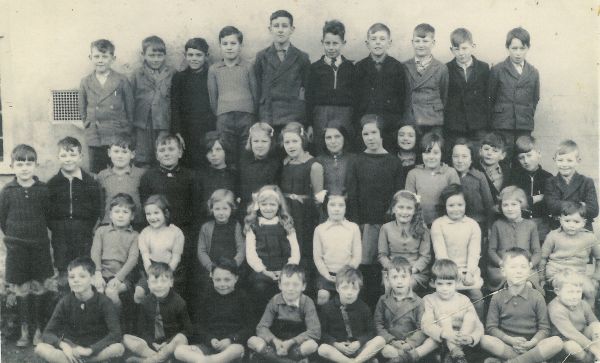
This picture of the schoolchildren at Chitterne Primary School appears in my book on the village but the list of children beneath the picture is not accurate. Thanks to my good researcher friends J & R, also known as Holmes and Watson, I can now amend some of the mistakes. This all came about due to the release of School Registers online, which J & R have used to good effect.
The Chitterne School Register starts in 1913 and ends in the 1940s when Chitterne School's population was enlarged by WW2 evacuees, mostly from the London area. Some of the evacuees do not appear on the register, and some village children appear twice!
The children are now from L to R, back row:Anthony Gerald Bailey; Charles George Goodenough; Terence A Gorry; Alan James Feltham; Trevor Johns (evacuee); Richard Brown (evacuee); unknown; John Bowler (evacuee); unknown; unknown.
Second row: Terence Wells; Norman C Bowler (evacuee); David Feltham; Bernard George; unknown; Mary Eva Goodenough; unknown; unknown; Teasie Doreen Gorry; Sylvia Mary Rose Feltham; Mary Florence Mould; unknown; John Williams; Maurice A Cauchois (evacuee); unknown.
Third row: Raymond Feltham; Winifred Johns (evacuee); Peggy Daniels; Patricia Mary Plumbley (evacuee from Bristol); unknown; Thelma Rose Herrington; Ruby Mould; Anne A Cruse; Earl George Gilbert Mould.
Front row: Gordon E Goodenough; William Albert Potter; Anthony Poolman; Robert H G Feltham; Ronald A Potter; Richard Lewis Feltham; Colin P Gorry; Raymond George Poolman; Arthur C Polden.
We are still looking for some of the unknowns on this picture so if anyone out there can fill in more blanks we would be very grateful.
Tuesday 23rd September 2014 - Researching Concrete Houses in Chitterne
You just never know what intriguing item is going to turn up next in your inbox! Today, after an exchange of such emails, DSC, the great grandson of Charles Drake, visited the village looking for houses built of concrete by a method patented by his great grandfather in the late 1860s. He had documentary evidence that some of the houses had been built here in the 1870s at the behest of the lord of the manor, Richard Penruddocke Long. I was intrigued because this was all news to me.
DSC suggested The Grange might be one of them after he had taken a google tour around Chitterne, but that turned out not to be the case because the render has fallen off in places and revealed stonework beneath.
A pair of houses in Bidden Lane did look very likely as they matched another pair built by the Drake method in Steeple Ashton. I spoke to the owner asking if we might visit and was amazed when he told me he knew for a fact that his house was built of concrete and that the pair of houses had never been finished due to lack of funds. The plan had been to add another gabled wing at the far end from his house. On the end wall at one time you could see the marks made by the metal shuttering during the build, but these had been rendered over by a previous owner. He had been told this by Bill Windsor many years ago. What he didn't know was the meaning of the RPL on the gable.
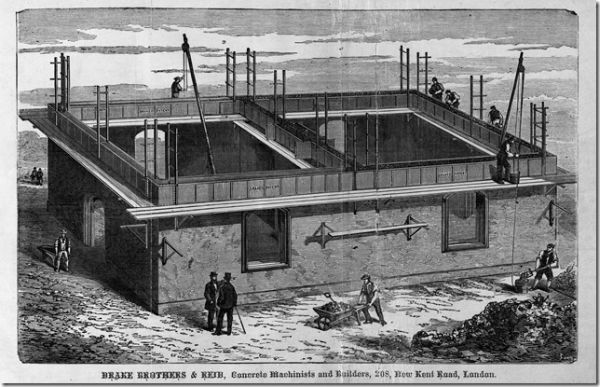
This method of building was a craze in Victorian times as it provided a solid construction at much reduced cost allowing forward looking lords of the manor to rehouse their farm workers in much more sanitary conditions. But the method was not only used for low end housing. DSC had am impressive portfolio of photos of buildings constructed by the Drake method including hotels, a theatre, many mansions and even a Turkish Bath with a domed concrete roof that is still in use in Glasgow. Many Drake buildings are now listed and recently one such in Lordship Lane, Southwark, London, has been renovated at a cost of £1.1 million. Sadly Charles Drake's advanced ideas were not endorsed by the architects of the day and his company was wound up in 1876.
Tuesday 1st July 2014 - Testing the Sportsfield with a Resistivity Monitor
It was almost a Time Team experience when a Canadian physisist, a cousin of a villager, brought his home-made Resistivity Device to try out in Chitterne. Having found the site of an old manor house in one of the Barford villages some years ago he was keen to monitor a site here. Luckily for us AK had seen the Wyvern Dowsers at work in May and suggested our sportsfield to him, and so it was decided to take resistance readings from the site of the old house the dowsers had pinponted (see previous blog).
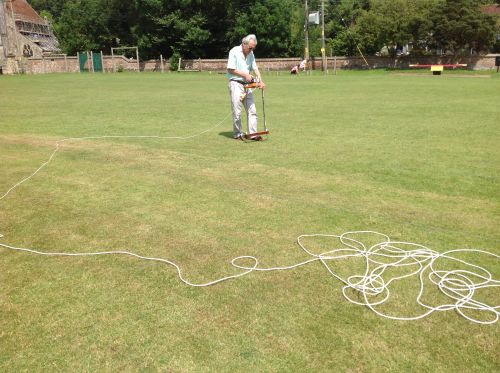
First a 20 metre square area was accurately marked out on the cricket pitch using measured lengths of plastic line pegged in place. The monitor would take readings from a square metre area each time its prongs were thrust into the ground so the 20 metre square was further divided into 1 metre squares by marks on the lines. A reading was taken from each square, 400 in all.
There was a moment of excitement when the monitor read-out changed significantly just over the spot where the dowsers had found a well.
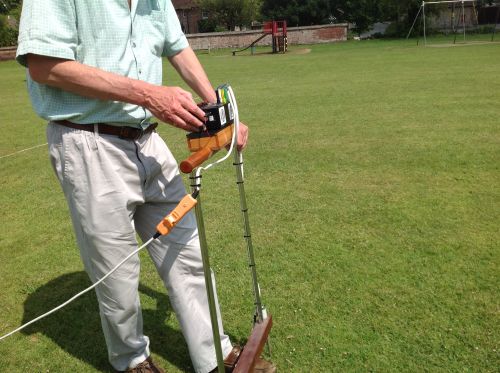
The readings are stored in the black box on top of the resistivity device and unfortunately will not be available until connected to a certain computer back in Canada. so we must wait patiently for the results and a change of opinion on the part of AK. He has said that he would shelve his scepticism of the dowsing results if the monitor agrees with them!
Sunday 25th May 2014 - Return of the Wyvern Dowsers
The Wyvern Dowsers paid a return visit to Chitterne today with two objectives: to find the whereabouts of St Andrews Chapel on the the Gate House site, and to find the site of the Great House in the sportsfield.
The dowsers found the Gate House site very ancient, possibly pre-Christian, and very peaceful. I told them what little I knew of its history, that St Andrews Chapel existed in 1142, that Hoare described it as once standing behind the old gabled building adjoinng the arched gateway and that Canner said some old stone coffins had been unearthed on that spot.
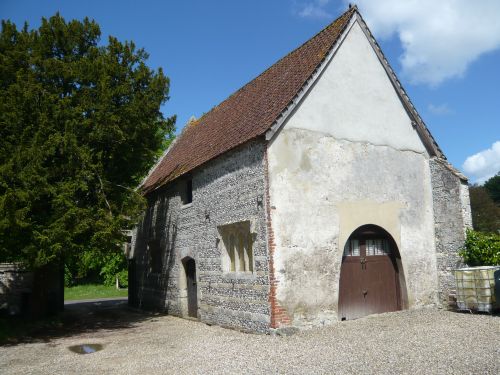
We studied the gabled building of banded flint which looks ecclesiastical with its arch-topped windows and door. The end of this building furthest away from the road has been altered. There are no stone quoins at the two rear corners as one would expect, these have been roughly replaced by old red bricks, and the end wall itself has been rendered over as if it was roughly filled in with rubble or cob around an arched opening filled by a pair of wooden garage doors. Maybe it was originally part of a larger building but later used for storage. There is a square opening at a higher level such as you might find on a hay barn. We speculated some on these ideas but came to no conclusions.
With those few clues the dowsers set off in different directions. They work by holding their dowsing rods loosely and pointing straight ahead then asking themselves a specific question to which they would like an answer. This proved to be difficult at the Gate House because the site is so old. Over the centuries many changes have taken place and the layers of underlying remains caused confusion. For instance, the dowsers found two distinct sites for the altar. So either the altar was moved at some point or, like so many others at the dissolution, it was buried in the hope of saving it from destruction until such time as it could be safely returned to use.
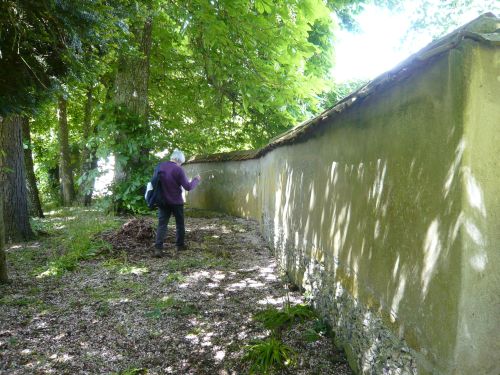
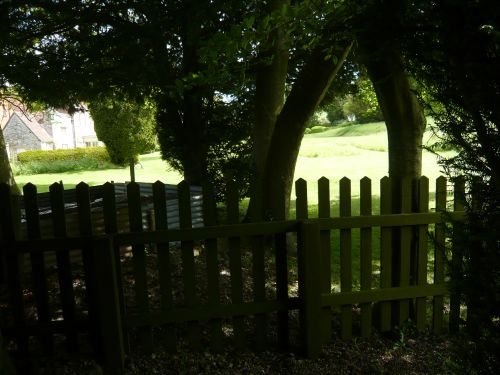
However, some of them were pretty sure that a 'chapel' stood beyond the gravel area behind the gabled building, bounded by a curving boundary wall and a hedge, with the altar sited behind a fence amongst some young trees in the grounds of Chitterne House.
The dowsers also found plentiful water. One source near the suspected 'chapel' site and another nearer the road and Chitterne Brook. They said that monastics were very adept at managing their water in medieval times. That they would probably have used the higher source for drinking and lower source for flushing away waste.
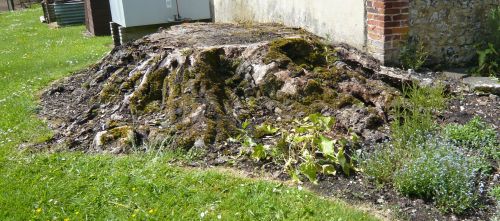
Another intriguing sight was the stump of a huge old tree between the Gate House and the paddock. It is very very ancient, possibly yew and several feet across.
In conclusion it was decided that the site would have been better dowsed with only two or three attempting it, rather than a whole group.
Comment on 29 May 2014: Ask your Geophys team if they could do the little field next to the chapel which shares the back wall to the chapel-like building. I made some yellow chalk marks in the road near there which shows the energy line which goes through the site of the altar, and this is typical of most churches. I think L was right when she says that the altar was between the two trees at the back. CH of Wyvern Dowsers (CH's mention of the Geophys team refers to an offer from AK to bring a geophys machine to the village to test it out. SR)
Comment on 31 May 2014: VP told me today that the tree stump is an old beech which was taken down not too many years ago. SR
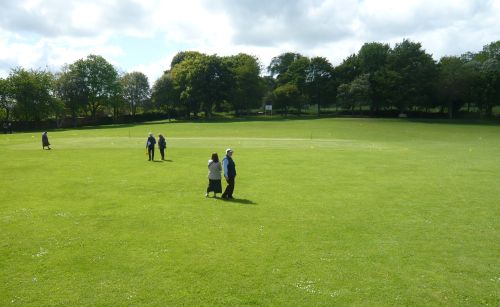
At the sportsfield I showed the dowsers where the entrance gateway to the Great House had once been in the remains of the boundary wall between sportsfield and garston field. I said the house probably burnt down in the 1820s and that the Coach House next door was once the stables and coach house to the Great House. I also told them to stay away from the wicket!
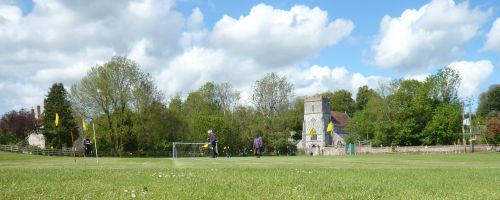
Here posing a dowsing question was much easier. The marker flags were brought out and were soon almost outlining the .... wicket. Could they walk carefully on the wicket? We decided they could with care and soon they were able to pinpoint the well, walls, chimney stack, doorways and whether the doorway had a porch or step, and even date the two sections of the building. One as specifically as 1420, which two dowsers dated independently, the other to 16th or 17th century.
At that point the cricketers arrived for nets, full of scepticism.
Friday 9th May 2014 - William Longespee and the Re-Issue of the Magna Carta
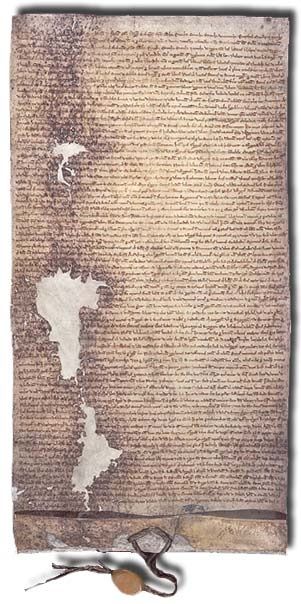
1225 Magna Carta
Me and my computer have been sick. I am recovered but my PC is not. I am trying to get my head around a new system. Bear with me.
King John's son, King Henry III, reissued the Magna Carta his father had signed originally in 1215, ten years later on reaching his majority in 1225. I am grateful to JP for pointing out that William Longespee, half-brother of King John, was present at the reissue.
JP says: "My research shows that Ela's husband William Longespee was actually present when Henry III reissued the Magna Carta, when he came of age in 1225. This version had his green seal and was much shorter than the original King John Magna Carta. William had a copy in his capacity of High Sheriff of Salisbury; when he died it was handed to Ela, as she was the High Sheriff, but when she retired from public life and joined the Abbey, it should have been handed on to the next High Sheriff. Instead it went with the rest of her papers to Lacock. It is possible that it was overlooked because so few people could read. Anyhow, I expect you know that, that copy remained at Lacock until just after the war, when it was given to the British Museum (I think it is now in The British Library) Only 2 copies remain, the other one is in Durham university I think."